How Disputed Manages Chargebacks: Root Cause Analysis That Stops the Next One
The Disputed Team · Last updated October 2026
Key takeaways
- Disputed answers four questions for every chargeback (what happened, why, how to resolve it, and whether to fight it) in under 20 seconds, and records the answers in the same fields every time.
- The bank’s reason code is a claim to check against the evidence. Mastercard reports that around 45% of chargebacks are filed as fraud, and that 48% of consumers have disputed a charge they later realized was legitimate.1 In one merchant portfolio we analyzed, about 40% of disputes labeled “Product Unacceptable” were really subscription cancellations.
- Records with matching fields let Disputed read cases together. At one merchant in the first half of 2026, reading cases together turned up 869 accounts filing repeat fraud claims that each looked ordinary on their own, but together matched the pattern of a fraud ring.2
- Disputed recommends fighting a chargeback when the merchant is right and accepting it when the customer is right, with the fix sent back to the part of the business that caused it.
- We believe many chargeback causes are within the merchant's control, such as a billing descriptor customers don't recognize or a refund that takes longer than a call to the bank.
- Disputed's method needs volume to pay off. A merchant with a handful of chargebacks a month can read them by hand.
What's wrong with how most teams handle chargebacks?
Most teams we’ve talked to handle chargebacks one at a time.
They answer and close each case on its own, so nobody sees what the cases have in common. Before you ask, no, the reason code doesn't fill that gap. Visa reason code 13.1 records what the cardholder claimed, but the code tells you nothing about why the cardholder called the bank instead of the merchant.3 And sometimes the code is simply wrong. A customer who received their order but didn’t like it can still end up filed under fraud. Visa estimates that about 20% of fraud disputes are really friendly fraud (first-party misuse), rising to 30% for high-volume online merchants.4
So the code can’t tell you the cause. This is why we believe most chargebacks start as a customer service problem.
If you've ever gotten a support ticket that says, "I'll just go to my bank," you know this. For many customers, the bank is now the fastest customer service there is. That's why you need to be faster than the bank.
Shawn Kelley, our co-founder and CEO, built the risk and payments platforms at SeatGeek. When he looked at the enterprise chargeback solutions on the market, he found none that were actually solving chargebacks, so he co-founded Disputed.
In this post, we walk you through the method we use at Disputed to help you win more disputes and stop chargebacks from happening in the first place.
How does Disputed review every case?
Disputed reviews every chargeback by answering four questions: what happened, why it happened, how to resolve it, and whether to fight it.
Merchants connect Disputed to the data warehouse they already have, with read-only permissions, and to their payment processors. Each case arrives as the bank’s side of the dispute (the reason code, the issuer’s memo and any documents the bank attached) alongside the merchant’s order data, support threads and carrier scans. Disputed works the dispute end to end, from review to submitted response.
Review and response take under 20 seconds.
Here is what one review looks like. The case below is sample data, shown to illustrate the format.5
Order 73184, two items, shipped September 2, promised by September 6. The customer says neither item arrived. Visa reason code 13.1, item not received. The issuer’s memo repeats the claim with no new detail.
The carrier scanned delivery to the address on the order on September 5, before the promised date. The package weight matches both items. The customer did not contact support before filing.
Represent with proof of delivery to the order address, the shipment weight matching both items, the item details matching the order, and the shipping policy the customer accepted at checkout.
Fight: the merchant is right and the evidence is strong.
Order confirmation with item details and promised delivery date, carrier proof of delivery with address, shipment weight record, shipping policy accepted at checkout, support history showing no contact.
Why doesn’t Disputed trust the reason code?
Disputed treats the reason code as the bank’s claim and checks it against two other sources before deciding anything.
Banks pick the code fast, often from a short phone call or a few taps in a banking app. So for every case, Disputed reads three things side by side:
The reason code.
The issuer’s memo and any documents attached. Platforms like Shopify Payments now show these memos to merchants, and they often tell a different story than the code.6
Support emails, order history and delivery scans.
When all three agree, the case is simple. When they don’t, the mismatch is the finding. In one merchant portfolio we analyzed, about 40% of disputes labeled “Product Unacceptable” were really subscription cancellations, a different problem that needs different evidence and a different fix.
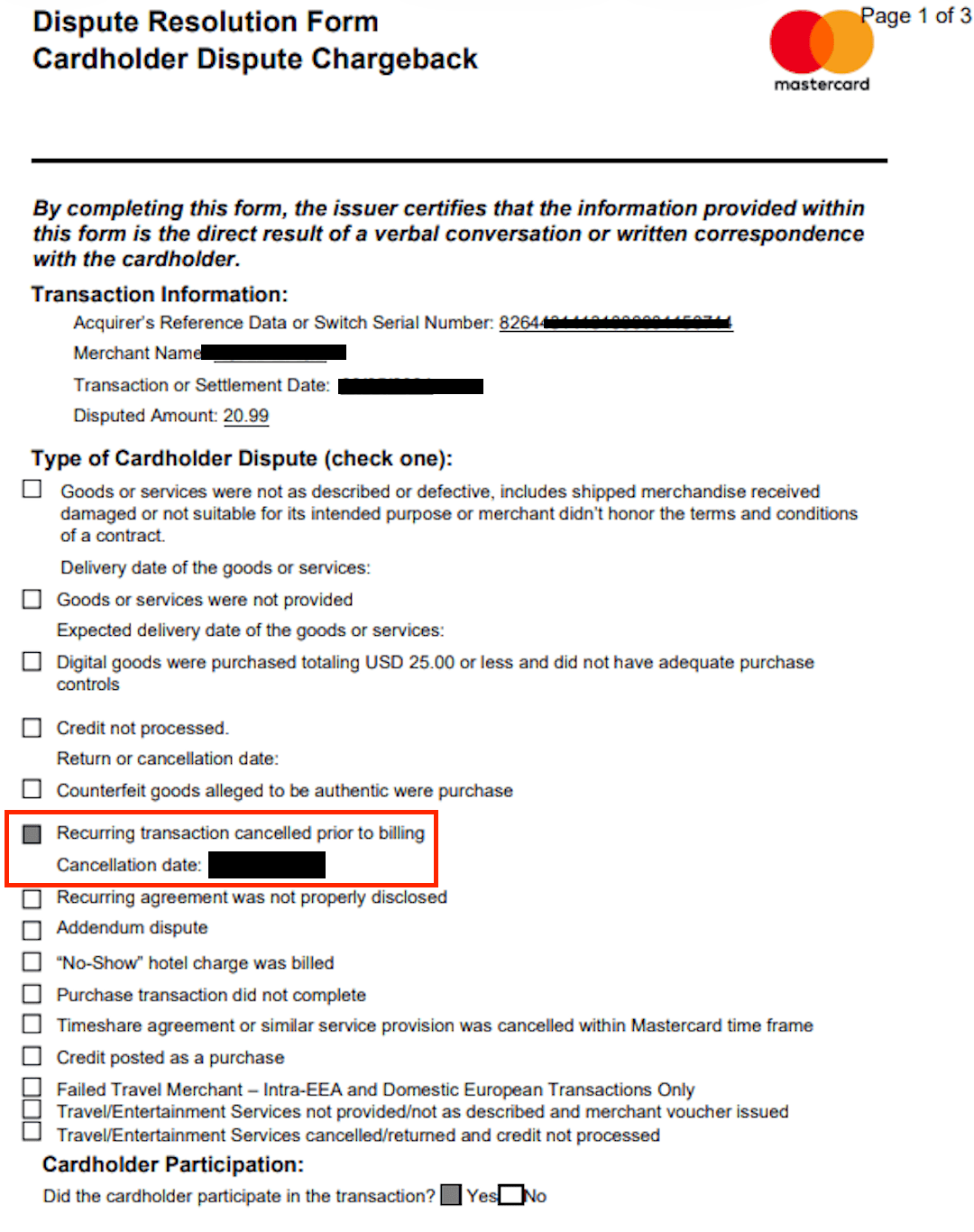
When the code and the facts disagree, Disputed does two things:
We answer the code as filed, because the bank judges the response against the conditions of the code it chose.
We answer the real claim. If the customer emailed support about the product, that email shows they made the purchase. If the merchant did nothing wrong, the email goes into the response too.
If the merchant did get something wrong, Disputed says so. The case is recorded as merchant fault, even if the bank filed it as fraud, and the recommendation is to accept. The cause goes on the fix list.
Because every case stores the real cause alongside the bank’s label, Disputed can group cases by it later: which products draw fraud claims that are really complaints, and where support was slower than the bank.
Why does Disputed turn every case into structured data?
Disputed turns every chargeback into structured data with the same fields every time, because cases that share a shape can be read together as a group.
Order data, support threads and carrier scans come in however the merchant keeps them. Every case goes out as the same record: what happened, why, how to resolve it, whether to fight, what the bank filed versus what really happened, and the evidence behind each answer.
Records with matching fields can be sorted by account, by cause and by month, which a folder of closed case files does not allow.
How does Disputed decide which chargebacks to fight?
Disputed decides whether to fight a chargeback by asking who is right, the merchant or the customer.
A win on the locked-account case would recover one sale and leave the lock in place for the next customer. Judging who is right decides where the work goes: evidence for the cases the merchant should win, and a fix for the cases it shouldn't.
How does reading cases together expose repeat filers and fraud rings?
Reading chargebacks together exposes repeat filers because Disputed can group every claim by account, and a pattern that is invisible in one case shows up across many.
At one merchant we work with, in the first half of 2026. Each claim looked ordinary on its own. Together, the claims matched the pattern of a fraud ring.2
At the same merchant, spread thin enough to slip past the usual checks.2
Disputed fights the claims the merchant should win and flags the accounts, so the merchant can block each account's next order and recoup what it cost. Both lists then go to the merchant's fraud team.
Reading cases together has also surfaced:
- Customers who received their order telling their bank the purchase was fraud.
- Dark-web services that file false chargebacks on behalf of buyers and take a 20% cut.
- One integration setting that left Apple Pay chargebacks on the merchant.
How does Disputed turn chargebacks into fixes?
We believe a chargeback you prevent is worth more than one you win, and that a lot of friendly fraud starts with something the merchant can change.
This is why we focus on turning chargebacks into fixes: tracing each chargeback pattern to a root cause and naming what the merchant can change to prevent the next one.
We think fixing causes upstream matters more now, because customers are teaching each other how easy the bank is to reach.
In September 2026, a social post asking whether fans could get their money back for a concert through their card company got 600,000 views.7 The top replies were instructions, including:
"Easy as one phone call."
Top reply to a social post, September 2026A few told people to tell the bank the card was stolen, which turns a refund request into a fraud claim.
Your customer service team needs to respond to customers faster than the bank does. In the future, even that won't be enough (more on that below).
How is Disputed different from other chargeback management tools?
Disputed differs from other chargeback management tools in the judgment we apply to every case and in the patterns we find across cases, including fraud. Responding to chargebacks is the easy part, and in our experience, most vendors automate it.
Disputed does full dispute response, end to end, but the harder work is judgment: which cases to fight, what is driving them, and which accounts to flag.
When isn't Disputed the right fit?
Disputed is the wrong fit for a merchant whose chargebacks are too few for patterns to show. With a handful of chargebacks a month, reading them by hand in a spreadsheet with the same columns gets most of the value.
Some chargebacks are true third-party fraud, where the card really was stolen. The fix for those sits in fraud screening, and a clearer descriptor or a faster refund won't stop them.
Some causes sit with the card issuer, outside anything a merchant can change.
Where are chargebacks headed?
Today a chargeback takes one phone call. We think that before long, it will take one sentence to a customer's personal AI agent, which will file it on their behalf in seconds.
The fraud teams that come out ahead will read every friendly-fraud chargeback as a customer telling them what went wrong, and fix the cause before the next one arrives.
What should you do next?
Start by reading last quarter's chargebacks as one data set.
Answer the four questions (what happened, why, how to resolve it, whether to fight) for each chargeback, in the same columns.
Put the reason code next to the bank’s memo and the customer’s support history. Flag every case where they disagree.
Group the records by account and look for accounts with more than one claim.
Go upstream, find the cause behind the most disputes, and fix it first.
Related
- What Counts as Compelling Evidence for a Visa Dispute?
- Mastercard First-Party Trust: What Reason Code 5002 Actually Changes
- Chargeback Response Deadlines by Network and Reason Code
Sources
-
Mastercard, “What is the true cost of a chargeback for businesses?”: fraud chargebacks are around 45% of merchant chargeback volume globally (2025 data), and 48% of consumers have mistakenly disputed a legitimate charge (2026 research with Datos Insights). mastercard.com ↩
-
Disputed case data, one merchant (unnamed), January to June 2026: 869 accounts with repeat fraud claims and 232 accounts with repeat non-fraud claims. Internal data, not published. ↩ ↩2 ↩3
-
Visa Core Rules and Visa Product and Service Rules, 18 April 2026 edition, §11.10.2 "Dispute Condition 13.1: Merchandise/Services Not Received," p.744. visa-rules-public.pdf ↩
-
Visa, “Friendly fraud explained: prevention and solutions”: friendly fraud is around 20% of fraudulent disputes globally, up to 30% for high-volume online merchants. corporate.visa.com ↩
-
CASE-2487 and the locked-account case are illustrative sample data from Disputed's product, not real customer cases. ↩
-
Shopify Changelog, “Issuer memos now available for disputes,” March 2, 2026. changelog.shopify.com ↩
12Frequently asked questions
What is chargeback root cause analysis?
Chargeback root cause analysis is working out why a customer filed a chargeback, beyond the reason code the bank attached. Disputed does it by answering what happened, why, how to resolve it, and whether to fight for every case, in the same fields, so cases can be read together.
How long does Disputed take to review a chargeback?
Disputed reviews and responds to a chargeback in under 20 seconds. The sample case CASE-2487 was ready in 18 seconds.
Can Disputed run my whole dispute operation?
Yes. Disputed works every dispute end to end, including the response.
Can Disputed replace my current chargeback vendor?
Yes. Disputed works every dispute end to end, from review to response, and can run a merchant's full dispute operation.
Will Disputed tell me not to fight a chargeback?
Yes, when the customer is right. In one illustrative case, a customer's account was locked before an event and the customer declined full credit and went to the bank; Disputed's verdict was don't fight, and fix the lock.
How does Disputed find serial disputers?
Disputed finds serial disputers by grouping every claim by account. At one merchant in the first half of 2026, 869 accounts filed repeat fraud claims and 232 filed repeat non-fraud claims; Disputed fights the claims the merchant should win and flags each account so the merchant can block that account’s next order.
What data does Disputed need?
Disputed needs read-only access to the merchant’s data warehouse and a secure connection to the payment processors it already uses. Each case draws on order data, support threads and carrier scans.
Does Disputed trust the bank’s reason code?
No. Disputed treats the code as the bank’s claim and checks it against the issuer’s memo and the merchant’s own data. When they disagree, Disputed answers both the code as filed and the real claim, and records where the fault actually sits.
By the Disputed Team. Disputed sells the service described here. Sources are listed above.